Why the outbound direction is the harder one
Most of what we do on this site runs inwards. A document is issued somewhere else, it arrives in Singapore in a language a Singapore authority cannot read, and we translate it into English, certify it, and – where the authority asks – have the certificate notarised. The receiving body is a Singapore body. We know what it wants because we deal with it constantly, and because its requirements are published. If you have read our note on certified versus notarised translation in Singapore, that is the inbound picture.
This job ran the other way, and the whole logic inverts. The document was already in English, already Singaporean, and already valid where it stood. The problem was that it had to go out – into a jurisdiction with its own rules about who is allowed to translate a legal instrument, its own view of what a foreign notary’s signature proves, and its own counters staffed by people who will either take the bundle or hand it back.
Outbound work has a structural difficulty that inbound work does not. On an inbound file, we are producing for a reader we can ask. On an outbound file, the Singapore side has to manufacture something the Indonesian side will accept, and the Indonesian side is not on the phone. Every choice – what gets notarised, what gets apostilled, in what order, with what attached to what – is made in advance and cannot be unpicked afterwards. A notarial certificate, once signed and stapled, is a fact. An apostille attached to the wrong sheet is not a mistake you fix; it is a mistake you redo, at a counter, on a new appointment, with the deadline gone.
So the order of the chain is the real deliverable. The translation is the easy part.
Indonesia stopped being a consular destination in 2022
There is an old habit in this trade of sending anything Indonesia-bound through the Indonesian embassy. For years that was correct, and for anyone who learned the job before 2022 it is still the reflex. It is now wrong, and quoting it as current advice will get a client sent on a journey that ends at a closed window.
Indonesia deposited its instrument of accession to the Hague Apostille Convention on 5 October 2021, and the Convention entered into force for Indonesia on 4 June 2022. Singapore has been a party since 16 September 2021, with the Singapore Academy of Law designated as this country’s competent authority for issuing apostilles – the register and request channel sit at legalisation.sal.sg. On the Indonesian side, the competent authority is the Directorate General of General Legal Administration at the Ministry of Law and Human Rights. On the same date the Convention took effect, Indonesia’s Ministry of Foreign Affairs circularised its missions abroad to confirm that public documents from Convention states no longer require legalisation by an Indonesian embassy or permanent mission before use in Indonesia. An apostille from the issuing country’s competent authority replaces it.
Two countries in the Convention, one apostille, no embassy. That is the clean version, and for a Singapore document going to Indonesia it is the version to work from. Our Hague apostille service and the wider document legalisation route both exist on this basis.
Here is the honest caveat, and we gave it to Goh in writing rather than burying it. The legal position changed on a single date; counter practice did not. Indonesian authorities had to rewrite internal procedures, and not all of them did so at the same speed. There are documented instances from the months after June 2022 of Indonesian officials still asking for embassy-legalised papers, or asking for a statement from the embassy confirming that it can no longer legalise – while the embassies themselves had already stopped. Practitioners in Jakarta responded by advising exactly what we advised: ask the receiving body what it will take, before you build the bundle, and if that body genuinely cannot process an apostille yet, deal with that as a known problem rather than discovering it at the window.
That caveat is not a reason to go back to the consular route by default. It is a reason to identify the counter.
Finding the institution hiding behind “Overseas Use”
“Overseas Use” is not a purpose. It is the field a form offers when nobody has asked the only question that matters, and a two-word answer that could mean any of a dozen incompatible things.
We went back to Goh with one question, phrased as plainly as we could: who, in Indonesia, is going to be handed this? Not which city, not which company – which desk. A notaris drawing up a deed. A district court registry. A land office registering an interest. A bank’s compliance team. The company registry. Immigration. A university. Each of those has a different appetite, and the differences are not cosmetic.
A notaris working on an Indonesian deed will often want the foreign instrument’s content in Bahasa Indonesia so it can be recited or annexed, and will care a great deal about who produced the Indonesian text. A court registry cares about the authenticity of the foreign public document and will look hardest at the apostille. A land office works from a closed list of acceptable evidence and tends to be the least flexible counter in the chain. A bank is applying an internal policy that may be stricter than the law. A company registry wants form compliance above all.
The practical consequence is that the answer to “which paper gets the apostille” is set by the receiving body, not by us and not by the client’s preference. And because the chain is irreversible once signed, this question has to be settled first. On an outbound job, asking it is not administrative throat-clearing. It is the first substantive act of production.
What a Singapore notarisation actually proves – and what it does not
This is the part of the conversation that costs us a little commercially and earns us the client, so we have stopped trying to make it sound better than it is.
Indonesia operates a sworn-translator regime. A penerjemah tersumpah is a translator formally appointed and sworn under Indonesian law, and their translations carry a status inside Indonesia that an ordinary translation does not. The regime has moved. Historically, translators were sworn in by regional heads – the Governor of DKI Jakarta in Jakarta, the Governor of East Java in Surabaya – which meant a translator’s standing was provincial, and which left a long gap with no new appointments at all. The ministerial regulation of 2016, amended in 2019, moved appointment to the national level under the Minister of Law and Human Rights, and oath-taking resumed in 2022 after roughly a decade’s pause. Anyone citing “sworn before the governor” as the current rule is describing the system that was replaced.
Now the limit, stated flatly. A notarisation performed in Singapore authenticates a signature. When a Singapore notary public notarises a translator’s certificate of accuracy, what is being attested is that the person who signed it is who they say they are and signed it in the notary’s presence. It does not make that translator a penerjemah tersumpah. It cannot. No notary in Singapore, and no apostille from the Singapore Academy of Law, can confer a status that only Indonesia grants. An apostille authenticates the Singapore official’s seal and signature; it says nothing whatever about the quality or standing of the translation underneath.
So if the Indonesian receiving body requires a sworn Indonesian translation, the correct answer is that the Indonesian text will have to be produced or re-produced by a sworn translator in Indonesia, and our job narrows to delivering an apostilled English original clean enough for that to be done on arrival. If the receiving body will accept a notarised translation produced abroad – and many will, for many purposes – then the Singapore chain is the whole answer. Knowing which of those two worlds you are in before you spend money is worth more than anything we could promise about speed. It is also the reason we would rather tell a client to spend less with us than sell a bundle that comes back.
Settling the chain order
With the sector identified and the sworn-translator question resolved, the chain had to be fixed in a specific sequence. Three candidate papers existed and only one answer was right.
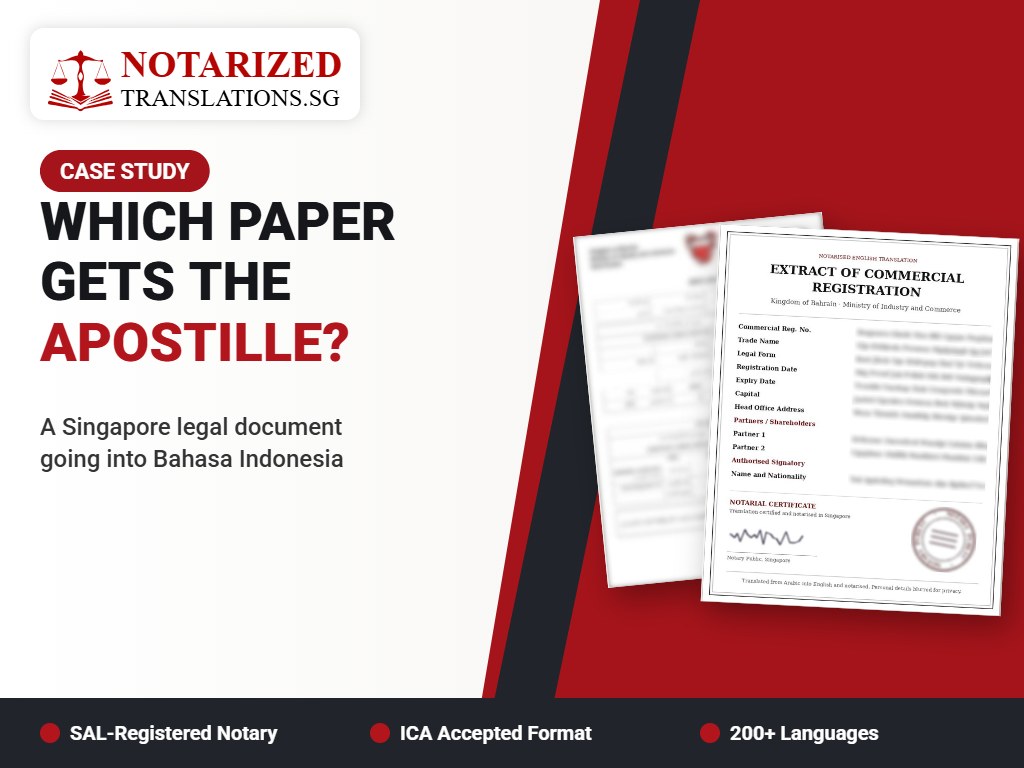
The source instrument is a Singapore document. If the receiving body needs the original authenticated, the apostille belongs on the original, or on a notarially certified true copy of it, and the Bahasa Indonesia translation travels alongside as an attachment. If the receiving body needs the translation to be the authenticated object, then the translator’s certificate of accuracy is notarised, and the apostille goes onto the notarial certificate – because the notarial certificate is what carries a Singapore official’s signature, and a signature is the only thing an apostille can authenticate. The translation itself cannot be apostilled directly; there is no Singapore official signature on a translator’s page for the Academy to authenticate until a notary has put one there.
That last point is where outbound files go wrong most often. People ask for “an apostilled translation” and assume it is a single object. It is not. It is a notarised translation whose notarial certificate bears the apostille, and the physical assembly – what is bound to what, in what order, with which pages initialled – determines whether the apostille is attached to the right thing. We set that assembly out for Goh in writing before anything was signed, so that the sequence was a decision he had made rather than a surprise he received. Our SAL notarised translation service page covers the mechanics, and there is a fuller explanation of the Academy’s role in our piece on what SAL authentication is and when you need it.
Two phone photographs, and what an image has to prove
The upload was two files from a phone camera. For a lot of document families that is fine. For a legal instrument it is a starting point, not a source, and we check it against a short list before anyone translates a word.
Margins must be intact on all four sides of both pages, because a legal instrument’s margins carry things – initials, marginal notes, revenue stamping, a stamp-duty endorsement. A photograph taken at arm’s length over a desk crops the bottom edge more often than people expect. Signature blocks have to be fully in frame and legible enough to transcribe accurately, including anything printed beneath a signature. Seals and chops need enough resolution that we can read them rather than guess; an embossed seal photographed flat under room lighting frequently cannot be read at all, and an embossed seal rendered as “[seal]” with no description is a weak point in an outbound bundle. Page-of-page markers matter because they tell us whether two pages is the document or two pages is what fitted on the desk. And any instrument that refers to a schedule, an annexure, an exhibit or an appendix has to have that attachment, or the translation will be internally incomplete in a way the receiving counter will notice before the client does.
There is also the question of what gets notarised. A notary dealing with a copy is dealing with a copy, and if the receiving body wants a certified true copy of the source instrument, a phone photograph will not serve – the physical document, or a properly produced copy, has to be in front of the notary. We set out when an image is and is not enough in our note on using a scanned copy for notarised translation in Singapore, and the answer on this file followed that logic rather than the convenience of the upload.
Bahasa Indonesia as a legal target
Translating common-law English into Indonesian legal register is not a dictionary exercise, and the places it breaks are predictable.
Common-law instruments carry terms of art with no clean one-to-one Indonesian equivalent, because the underlying concepts developed in a different system. Equitable interests, trusts, consideration, estoppel, the distinction between a deed and an agreement – each of these has to be rendered in a way that preserves the legal effect rather than reaching for the nearest-looking Indonesian word, and in several cases the right answer is to render the concept and retain the English term in brackets so the Indonesian reader is not misled by a false friend. Party descriptors, recital conventions and execution formalities also differ, and a translation that silently reshapes them into Indonesian house style has altered the document.
The standing rule we apply to any bilingual instrument is that the governing-language clause is respected, never harmonised away. If the instrument says the English text governs, the Indonesian version is a translation of a governing English text and must present itself as exactly that, with the governing-language provision rendered faithfully and not quietly flattened into something that reads as though both versions are equal. Translators who “improve” that clause have created an ambiguity about which text controls, which is the single most expensive error available on a bilingual legal file. Names, places and official titles are transliterated consistently and mapped in a translator’s note rather than being varied from page to page, and seals, stamps and handwritten annotations are described rather than omitted.
None of this is visible in a quote. All of it is visible to the person at the receiving desk.
What went out, and where the file stands
The Bahasa Indonesia translation was produced complete – both pages in full, nothing summarised, seals and stamps described in place, signature blocks rendered with the handwritten elements marked as such, transliteration fixed and noted. The translator’s certificate of accuracy was prepared to sit with it. The notarisation was carried out by a SAL-registered notary public, and the apostille was requested from the Singapore Academy of Law against the sheet the chain order had identified, not against whichever page happened to be on top. The bundle was assembled in the agreed sequence and delivered inside the client’s deadline, within two to three working days, with nothing queried back to us at any stage.
What we did not do is tell Goh what the Indonesian institution would decide. That decision is not ours and we will not forecast it. What we could tell him, and did, was that the file going in was complete, that it was authenticated in the order the receiving body had indicated it wanted, that the apostille sat on a document that could legitimately carry one, and that if the body turned out to require a penerjemah tersumpah after all, the English original he now holds is apostilled and ready for that to be done in Indonesia without starting again. He confirmed the bundle did the job it was built for.
If you are sending a Singapore legal document out to Indonesia – a power of attorney, a property deed, an affidavit, an agreement – the useful order of operations is the one this file followed. Find out which desk receives it. Ask that desk whether it needs an apostille, a sworn Indonesian translation, or both. Settle which paper carries the authentication before anything is signed. Then translate. Doing it in that order costs a few days at the front. Doing it in any other order costs the deadline.