An Enquiry With the Purpose Field Left Blank
Read Ani’s submission as a specification and it falls apart in your hands. The source language is clear. The target language is clear. The page count is clear. The deadline pressure is implied by the fact that someone filled in a web form before eight in the morning. But the three fields that determine the product – certifier, authentication, purpose – do not agree with each other.
The certifier field says SAL. The notarisation box says yes. And the purpose says Not Sure. Those cannot all be true at once in any useful sense, because SAL authentication and an apostille exist for a reason, and the reason is a destination. You cannot name a destination’s authentication and then not know the destination.
We did not treat this as the client’s error. People who have never commissioned a translation of a civil record have no reason to know that there are three separate products with three separate purposes sitting behind the phrase they typed in their own message: an official English “translation/notarization”. That slash is doing an enormous amount of work, and it is doing it wrongly.
Why “Personal Document” Told Us Almost Nothing
The intake form had also classified the file as a Personal Document. It is a true description and a useless one. A personal document can be a birth certificate, a marriage certificate, a police clearance, a bank letter, a school leaving certificate or a statutory declaration, and those six things are handled six different ways.
We could see from the uploaded file name that the document was a birth certificate, which is why the job did not stall. But the gap between what the form recorded and what the document was is exactly the gap that produces a wrong quote. A generic classification invites a generic answer, and a generic answer on a civil record is how people end up paying for authentication layers that the person at the counter has no interest in.
So the first thing our team did was not quote. It was ask.
Three Different Products Hide Behind One Slash
When Ani wrote “translation/notarization”, two distinct services were being compressed into one request, and a third was hovering behind the word SAL. Pulling them apart is the single most valuable thing a translation provider can do for a first-time client, and it takes about four minutes.
Certification travels with the translator
A certified translation is a complete, faithful rendering of the document, accompanied by a signed statement from the translator or the translation company confirming that it is complete and accurate, identifying the languages, and giving the signatory’s details and date. The weight of that statement rests on the translator. It is a professional assertion about the content of the translation, and it is the only one of the three layers that says anything at all about accuracy.
Notarisation travels with the notary
A notary public in Singapore witnesses and attests the signature on that statement. The notary confirms who signed, that the signature is genuine, and in what capacity the signatory acted. That is the whole of it. This is the point most applicants miss, so we say it plainly in every scoping call.
Legalisation travels with the state
Above the notary sits authentication by the Singapore Academy of Law, and above that – for countries party to the Hague arrangements – the apostille. SAL is Singapore’s designated competent authority for this. An apostille presumes the authenticity of the signature on the document, the capacity in which the signer acted and the identity of any seal or stamp. It expressly does not certify the contents of the underlying document. SAL publishes the current procedure and fees at legalisation.sal.sg, and that is the only source we quote to clients on it.
Three layers, three different things being vouched for: accuracy, identity, and official capacity. Nobody needs all three by default. If you want this handled end to end rather than reasoned out from first principles, that is what our SAL notarised translation service is for.
A Notary Signs for the Signature, Not for the Sentence
Here is the consequence that matters. A notary public does not read the source language, and does not check that a date of registration has been carried across correctly or that a registering authority has been named in English the way the receiving officer expects. The notary is not qualified to do that and is not asked to.
So notarisation adds nothing whatsoever to the reliability of a translation. It adds a verified chain of identity on top of a translation whose reliability was already established, or already wasn’t, by the translator who signed it. An inaccurate translation that has been notarised is an inaccurate translation with a seal on it.
We spell this out because clients routinely buy notarisation as a quality guarantee. It is not one. It is an identity guarantee. The quality guarantee is the thing you choose when you choose who translates the document, which is why we front-load the linguistic questions and not the paperwork ones. When a receiving body does require the notarial layer, that is a requirement about chain of custody, and we meet it exactly as stated – see immigration documents notarised translation for how that works on an application file.
An Apostille Is a Passport for Paper Leaving the Country
The apostille question is where “Not Sure” costs real money, so this was the question we pressed hardest.
An apostille exists to make a public document issued in one country usable in another country, by replacing a chain of consular legalisation with a single certificate from the issuing state’s competent authority. The entire mechanism is about crossing a border. SAL is authorised to issue apostilles on Singapore public documents for use overseas in contracting parties, and to handle legalisation for outgoing documents heading to places that are not contracting parties.
Read that sentence again with the word outgoing in it. Now consider a Singapore applicant handing a translated birth certificate to a Singapore government counter. The document is not going anywhere. There is no foreign authority at the other end wondering whether a Singapore notary’s seal is genuine, because the authority at the other end is Singaporean and deals with Singapore notaries routinely.
What the apostille does not touch
Buying an apostille in that situation does not make a file stronger. It makes it dearer and slower, and it adds a certificate that the receiving officer did not ask for and has no procedure for. We have never once seen a domestic submission improved by an apostille that nobody requested. We have seen plenty of applicants pay for one, wait for it, and then discover the counter wanted something else entirely – usually a clearer scan, or a name that matched a passport.
The honest version of the advice is unglamorous: do not buy authentication until you know who is reading the document. If the answer turns out to be a foreign ministry, a foreign university or a foreign court, then the apostille is not optional and we will say so just as firmly – that is what our apostille service and our document legalisation services exist for. But the sequence is: identify the reader, then buy. Never the other way round.
The Six Questions That Turn “Not Sure” Into a Specification
These are the questions we sent Ani, in this order. They are not a sales script. They are the shortest path we know from a blank purpose field to a buildable job, and any competent provider should be asking them.
Who will actually read this document?
Not “what is it for” – people answer that abstractly. Who. A named department, a named counter, a named officer, a named portal. The reader determines everything downstream, and almost every client knows the answer the moment the question is phrased this way.
Does that reader name a certifier, or just require one?
Some bodies name a specific certifying route in their own published guidance. Others simply say the translation must be official. These are different instructions and they cost different amounts. Where a body names a route, we follow it to the letter and do not improve on it.
Will this paper ever leave Singapore?
The apostille question, asked without using the word apostille. If the answer is no, the conversation about cross-border authentication ends here and the budget stays in the client’s pocket.
Is the reader working from the original, a scan, or both?
Some submissions are portal uploads. Some require sighting of the original. Some require the translation to be physically bound to a certified copy. This changes what we produce, not merely how we post it.
Is there a second submission waiting behind this one?
A civil record translated once is often needed three times over the following year by three different bodies with three different standards. Knowing that in advance lets us build the version that satisfies the strictest reader, rather than the cheapest one that will need redoing.
What happens on the day after the deadline?
A deadline with nothing behind it is a preference. A deadline with an appointment, a lapsing pass or a closing window behind it is a constraint, and we schedule and staff differently for the second kind.
Scoping the Job Before Quoting It
Ani’s answers came back the same morning and the picture resolved immediately. The reader was a Singapore authority. The document was not leaving the country. The submission was a document upload, with the possibility that the original would be requested later. There was a real date behind the deadline.
That told us four things in one go. The translation needed to be complete and certified to a standard a government reader would accept without query. The notarial layer was worth keeping, because the receiving route contemplated a notary-attested translation and the client had already asked for it. SAL authentication was not required for a domestic submission. And the apostille – the thing the client had half-named in the certifier field – was simply not part of this job.
We said so in writing, in two sentences, with the reasoning attached, before any money changed hands. Then we quoted the job we had actually scoped. That conversation is the service; the typing is downstream of it. It is also exactly what the brief form at hire our translators is designed to start.
What Went Back to the Client
The delivered set was deliberately boring, which is the correct ambition for a civil record.
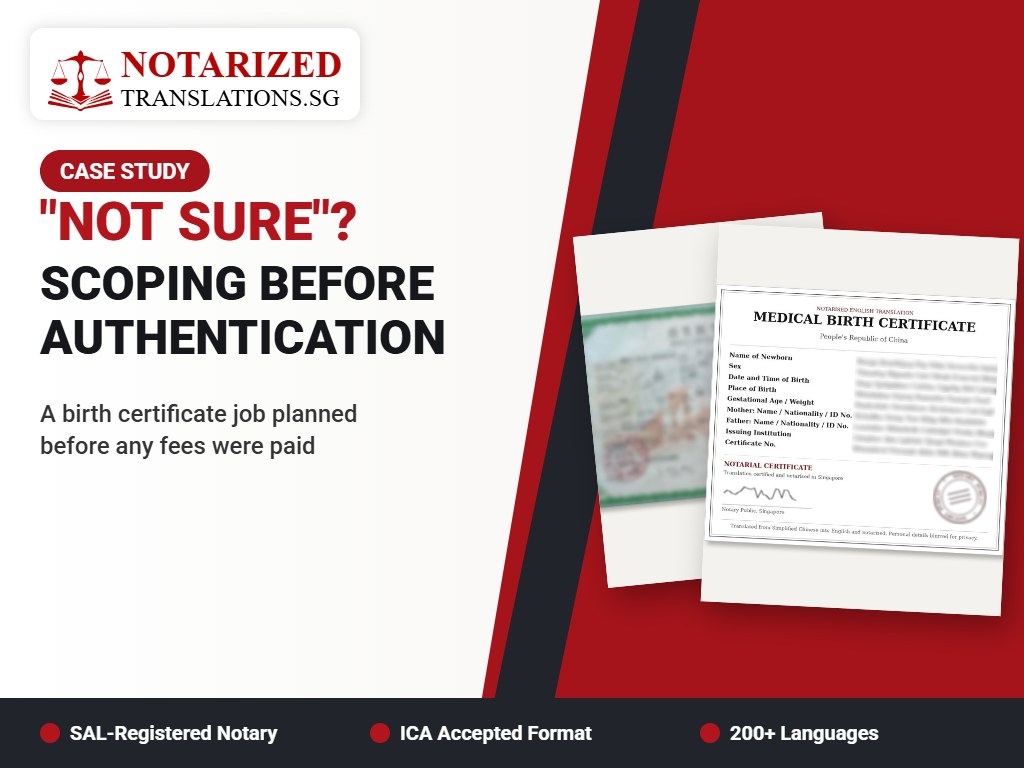
A full English translation of the single page, with every element carried across – the registering authority, the dates, the place of registration, the parents’ particulars, and every seal, stamp and endorsement described in place rather than silently dropped. Where the original carried something we could not render as a confident English equivalent, we said so on the face of the translation instead of guessing, because a flagged uncertainty is auditable and a smoothed-over one is not.
Behind that, a signed certificate of accuracy naming the languages, the document, the translator’s credentials, the date, and a statement that the translation is complete and faithful to the document supplied. Then the notarial attestation of that signature by a notary public in Singapore, exactly as the client had requested and the receiving route contemplated.
And nothing else. No SAL authentication. No apostille. No legalisation chain. Not because those are hard or because we would rather not sell them, but because there was no reader for them. The line item we were proudest of on that invoice is the one that was not on it. If the document type itself is where you are starting from, the birth certificate notarised translation page sets out the standard build.
Where the File Landed
The translation and the notarised certificate went out inside two to three working days of the scope being agreed, which was comfortably ahead of the client’s own date. The English version was certified and notarised in the form the receiving body accepts. Nothing in the set was queried, nothing was sent back for amendment, and Ani confirmed afterwards that the document did what it was needed for.
We are careful about what we claim beyond that. Whether an application succeeds is a decision that belongs entirely to the authority reading it, and no translation provider has any business taking credit for it. What we can say, flatly, is that the file went in complete and on time, with a translation that stood up and an authentication layer that matched its reader. For submissions where that reader is Immigration and Checkpoints Authority specifically, our ICA notarised translation service page sets out what that counter expects.
The lesson Ani took away was the one we would want any reader to take. “Not Sure” is not a weakness in a client – it is a normal starting position, and a competent provider should be able to resolve it in a morning with six questions. What it must never do is get resolved by buying the most authentication available and hoping some of it sticks. Authentication is not insurance. It is addressed mail. Find the address first.