Client details have been changed or withheld. No name, document number, address or figure from the documents appears in this account. The documents are described only in the general terms needed to explain the work.
The enquiry came in just after three in the morning, Singapore time, from the document submission form on this site. Three pages attached. Two sentences of explanation. A client wanted a notarised translation of a birth certificate and an academic certificate, Bahasa Melayu into English, for a Singapore citizenship application.
Three and a half hours later, a second lodgement arrived from the same person under the same order number. One page this time: the Malaysian birth certificate again, with a one-line note saying it was for the Singapore citizenship application. The client had not sent us a second job. The client had sent us the same document twice, because at six in the morning they were still awake and still not certain the first upload had gone through.
That detail is worth sitting with, because it tells you more about this kind of enquiry than any document type field ever will. People do not re-upload a birth certificate at 6:52 a.m. because they are disorganised. They do it because the application they are preparing is the one that decides where their life happens, and because somewhere in the back of their mind is a half-formed fear that a translation problem will be the thing that undoes it.
What actually landed on the desk
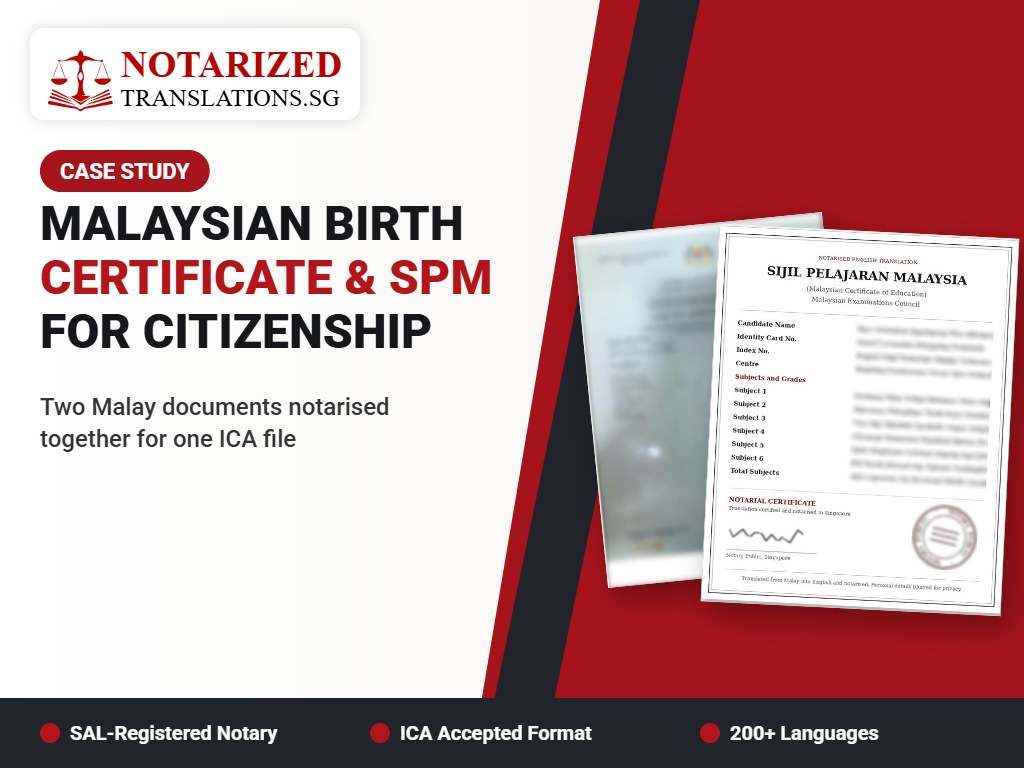
Two documents, both Malaysian, both in Bahasa Melayu, both needing to end up in English in front of the Immigration & Checkpoints Authority.
The first was a Malaysian birth certificate — a civil-registry record issued by the National Registration Department, Jabatan Pendaftaran Negara. It is the client’s identity anchor: it establishes who they are, where and when they were born, and the parentage on which a great deal of the rest of an immigration file depends.
The second was an SPM. Not a degree, not a transcript, not a diploma. The Sijil Pelajaran Malaysia is the Malaysian school-leaving examination certificate, taken at the end of the eleventh year of schooling and broadly equivalent to the GCE Ordinary Level across the Commonwealth or the GCSE in England and Wales. It is administered by Lembaga Peperiksaan Malaysia, the examinations board under the Ministry of Education. Its grade bands run from A+ down through A, A-, B+, B, C+, C, D, E and G, and the labels attached to those bands are themselves in Malay — Cemerlang Tertinggi, Kepujian, Lulus Atas, Lulus, Gagal.
Put plainly: one of these documents says who the client is. The other says what the client did at school. They came in the same email, they were going into the same envelope, and the client quite reasonably assumed they were the same kind of task.
They are not.
Why an identity record and an examination certificate are different evidential objects
This is the part of the job that the structured enquiry form had no way of capturing, and it is the reason this file needed thinking about rather than simply processing.
A birth certificate is a register extract. Its evidential weight comes from the fact that a state registrar recorded a fact at a point in time and the document is a faithful reproduction of that record. When you translate it, the thing that matters most is fidelity to the register: every endorsement, every stamp, every marginal annotation, every correction, the registration district, the serial, the signature block, the printed form text that surrounds the handwritten entries. The reader — an ICA officer — is checking that a person exists, that their parentage is as claimed, and that the names on this document reconcile with the names on everything else in the file. A missing marginal note on a birth certificate is not a cosmetic omission. It can be the thing the whole file turns on.
An examination certificate is a different animal entirely. Its evidential weight comes from an awarding body attesting to a measured result. The translation problem is not fidelity to a register; it is fidelity to a grading system that the reader may or may not recognise. An SPM presents subject names in Malay, grade codes in a Malaysian scale, and award labels that have no one-to-one English equivalent. The temptation — and we have seen other people’s translations do exactly this — is to “helpfully” convert the grades into something the reader will find familiar: to render a Malaysian band as a British grade, or to add an equivalence statement that the awarding body never made.
That is not translation. That is evaluation, and it is not a translator’s job. The moment a translator writes “equivalent to GCSE grade X” on the face of a translated certificate, they have inserted a claim the issuing authority did not make, and they have given a reviewing officer a reason to doubt everything else on the page. Our rule on examination documents is unbending: translate what the certificate says, transliterate the grade codes exactly, render the Malay award labels into plain English with the original term retained in square brackets, and let the receiving authority do its own equivalence assessment. If an equivalence statement is genuinely needed, it comes from an evaluation body, not from us.
So two documents, two entirely different translation disciplines — and yet one notarial bundle. Which brings us to the second hard part.
One notarisation, two documents: how the bundle holds together
Notarisation does not work document by document in the way clients usually imagine. The client’s mental model, and it is a very common one, was that each document gets “notarised” in the way each document gets stamped at a post office — two documents, two stamps, two fees, two visits.
What actually happens is this. The translator produces the translations and signs a statement of truth before a Notary Public appointed in Singapore. The Notary witnesses that signature, satisfies themselves as to who the signer is and in what capacity they are signing, and issues a notarial certificate. That certificate can attach to a bundle: the translations, the statement, and the copies of the source documents can be bound together, paginated, and covered by a single notarial act — provided the bundle is assembled properly, the pagination is unambiguous, and every page is identifiable as part of the same instrument.
Assembling it properly is the work. A bundle that mixes a civil-registry extract and an examination certificate has to make it obvious, on the face of the paper, which translated page corresponds to which source page, so that an officer who flips through it never has to guess. We paginate continuously, label each translation with the document it renders, and keep the source copies in the same order behind the translations. The notarial certificate then refers to the bundle as a whole.
Doing it as one bundle is cheaper, faster and — more importantly — tidier for the person reading it. Doing it as one bundle badly is worse than doing it as two, because a confusing bundle invites exactly the query the client is trying to avoid.
What ICA actually asks for — stated precisely, because this is where people guess
The client’s own words were that they needed a notarized translation. We want to be careful and honest about this, because it matters.
ICA’s published guidance for citizenship applications requires official translations of documents in languages other than English, submitted alongside certified true copies of the originals. The translations it will accept include those provided by the embassy or high commission of the issuing country, and privately produced translations that are either attested by the issuing country’s embassy or notarised by a Notary Public — in Singapore or in the issuing country. ICA also states, in terms, that it does not endorse any private translation company.
Read that carefully and you will see what it actually means. Notarisation is one of the accepted routes, and it is the route most applicants in Singapore take because a Notary Public here is the nearest and most practical option. It is not accurate for anyone to tell you that ICA demands notarisation and nothing else will do, and we will not tell you that. What is accurate is that a notarised translation by a Singapore Notary Public sits squarely inside what ICA says it accepts, that it is the route this client chose, and that it removes a category of doubt from the file. The client’s instinct was sound even if the reasoning behind it was approximate, and that is frequently how these enquiries arrive. If you want the longer version of that argument, our guide on notarised translation for a Singapore citizenship application sets out the document list in more detail, and our ICA notarised translation service page covers the submission side.
One more precision, because clients get this wrong almost every time. A notarial act confirms a signature, the signer’s authority and their capacity. It does not attest the accuracy of a translation. The Notary is not reading the Malay. The Notary is not checking whether Kepujian has been rendered correctly. The Notary is confirming that a named person, acting in a stated capacity, signed a document in front of them. The accuracy of the translation rests entirely on the translator’s own certificate of accuracy and the translator’s competence — which is precisely why the choice of translator matters more, not less, when notarisation is involved. We have written the full comparison in certified versus notarised translation in Singapore, and it is the single most useful thing a first-time applicant can read.
And because the question always follows: no, this file did not need Singapore Academy of Law authentication. SAL authenticates the signatures of Notaries Public appointed in Singapore under Rule 12 of the SAL Rules, and since 16 September 2021 it does so by affixing an apostille to the back of the notarial certificate. SAL does not review document content and does not assess translation quality. That layer is for documents travelling out of Singapore to a foreign authority. A citizenship application submitted to ICA, in Singapore, by a person living in Singapore, is not going anywhere. If your situation is the reverse — Singapore documents heading abroad — our SAL notarised translation service page explains the sequence.
Handling it step by step
- We merged the two lodgements into one job. First action, before any translation work: confirm with the client that the second upload was the same birth certificate, not an additional document. It was. Had we not asked, the client would have been quoted for four pages when the job was three, and would have received a bundle with the birth certificate in it twice.
- We corrected the purpose on our own record. The form said embassy certification and legal or court use. The client said citizenship. We went with the client, and we noted the discrepancy so that nobody downstream routed the job to an embassy step that does not exist in it.
- We assessed legibility before quoting. Malaysian birth certificates of a certain vintage are printed forms with handwritten entries, and both the printing and the ink can be faint by the time they have been photographed on a phone. We checked that every entry, stamp and endorsement was readable in the uploaded scan before committing to a deadline. Where a scan will not do, we say so early rather than late; the reasoning is in our note on using a scanned copy for notarised translation in Singapore.
- We built a names table before translating a word. This is the step nobody asks for and everybody needs. Malaysian names carry patronymics — bin, binti, a/l, a/p — and Malay orthography has changed over the decades, so a name spelled one way on an older birth certificate can appear differently on a school certificate issued years later, and differently again on a current NRIC or passport. We listed every personal name, place name and institution name appearing across both documents, fixed the English rendering of each one, and used those renderings consistently throughout the bundle. Where the source documents themselves disagreed, we transliterated each exactly as it appears and added a translator’s note recording the variance rather than silently harmonising it. Silent harmonisation is the single most dangerous thing a translator can do to an immigration file.
- We translated the birth certificate as a register extract. Complete and mirrored: printed form text, handwritten entries, registration particulars, the registrar’s signature block, the department seal, every stamp. Seals and stamps were described in bracketed translator’s notes giving their text and position, because a seal that is not accounted for reads, to a reviewing officer, as a seal that was ignored.
- We translated the SPM as an awarding-body attestation. Subject names rendered into standard English with the Malay retained where the subject has no clean equivalent. Grade codes transliterated exactly — never converted. Malay award labels translated plainly with the original term preserved in brackets. No equivalence claim of any kind. The certificate’s own security features, serial block and the examinations board’s imprint all accounted for in notes.
- We laid out both translations to mirror the source pages. Same order, same table structure, same position for the signature and seal blocks, so that an officer holding the Malay original beside the English can see line against line without hunting. Layout fidelity is not decoration on immigration documents; it is how a reader verifies quickly.
- We assembled, signed and notarised the bundle as a single instrument. Translator’s certificate of accuracy on top, translations paginated continuously, source copies behind in matching order, signed before a Notary Public appointed in Singapore, and the notarial certificate issued over the bundle as a whole.
- We delivered inside the client’s deadline — the hard-copy notarised bundle for the ICA submission, plus a scanned PDF of the complete bundle for the client’s own records and for the online upload.
What left our office
A single notarised bundle containing a complete English translation of the Malaysian birth certificate, a complete English translation of the SPM, a signed certificate of accuracy covering both, copies of both source documents in matching order, and one notarial certificate from a Notary Public appointed in Singapore. Continuous pagination. Every seal and stamp accounted for in a translator’s note. One consistent spelling of every name across all pages, with a recorded note wherever the source documents themselves differed. Nothing added, nothing evaluated, nothing harmonised in silence.
Turnaround on this file was our standard two to three working days, with a 24-hour express option available on request. Pricing for a notarised bundle of this size starts from SGD 50, with notarisation and any express handling quoted separately rather than folded into a single figure.
How it turned out
The bundle went out inside the deadline, notarised exactly as the client had asked for it. Nothing was queried — not the pagination, not the seal notes, not the treatment of the SPM grades. The client confirmed the bundle did its job and went into the citizenship submission complete and on time.
We will not tell you what happened after that, because it is not ours to tell. A citizenship decision belongs to ICA, it takes the time it takes, and no translator anywhere can influence it. What a translator can do is make sure that the translation is never the reason a file stalls — that when the officer reaches the Malay documents, there is nothing to ask about. On this file, there was nothing to ask about. That is the whole of what we promise and the whole of what we delivered.
The thing the client had most expected to hear was that the school certificate would be a separate job, with a separate notarisation and a separate wait. Being told otherwise was, by their own account, the most useful sentence in the whole exchange.
If you are standing where this client stood
A few things are worth knowing before you upload anything.
Send the whole set at once, and say what it is for. The purpose drives everything — which certification route applies, whether an authentication layer is needed, how the bundle is assembled. “Citizenship” and “court” produce genuinely different work. If you are not certain what to tick on a form, write it in the message box in your own words. We will read the words.
Do not re-upload in a panic, tell us instead. A duplicate upload under the same order is easy for us to spot and fix, but only if it arrives with a line of explanation. A silent duplicate is how people end up paying twice.
Gather the identity documents and the education documents together. They are different translation problems, as this file showed, but they are one notarial bundle and one deadline. Discovering the SPM a week after the birth certificate has already been notarised means a second notarial act that need never have happened.
Check your names first, not last. Pull out your NRIC or passport, your birth certificate and your school certificates and read the names side by side. If they do not match — different spelling, different order, a patronymic written one way here and another way there — tell your translator before work starts. A recorded translator’s note explaining a variance is a normal, boring part of an immigration file. An unexplained mismatch discovered by a reviewing officer is not.
Citizenship is not PR, and the paperwork is not interchangeable. If you are earlier in the journey, the requirements and the document set differ; we have written separately on notarised translation for a Singapore PR application, and it is the right starting point if PR is the stage you are at rather than the stage you have passed.
Questions people ask about this exact situation
Does my SPM need translating if the result slip is already in English?
The certificate and the result statement are different documents. If you are submitting the Malay-language certificate, that document needs an English translation regardless of what any accompanying slip says. If you are submitting only an English-language document issued by the awarding body, no translation of that document is required. Submit the document you were asked for, and translate whatever part of it is not in English.
Can the birth certificate and the SPM go into one notarised bundle, or do they need separate notarisation?
One bundle is normal and was what we did here. The requirement is that the bundle be assembled so that each translation is unambiguously matched to its source page, paginated continuously, and covered by a single notarial certificate. Separate notarisation is not wrong, just unnecessary and more expensive.
Will the Notary Public check that my Malay has been translated correctly?
No. This is the most persistent misunderstanding in the whole field. The Notary confirms a signature, the signer’s authority and their capacity. Translation accuracy is certified by the translator, in the translator’s own certificate of accuracy. Choose the translator on that basis.
Should the translator convert my SPM grades into O-Level or GCSE equivalents?
No, and you should be wary of anyone who offers to. A translation reproduces what the certificate says. Equivalence is an assessment made by an evaluation body or by the receiving authority, not a sentence a translator adds to a document. Grade codes are transliterated exactly; Malay award labels are translated with the original term retained.
Do I need SAL authentication or an apostille on top of the notarisation?
Not for a file submitted to ICA inside Singapore. SAL authenticates the signatures of Singapore Notaries Public, by apostille affixed to the back of the notarial certificate, and that step exists for documents being sent to a foreign authority. It adds nothing to a domestic submission.
What if the names on my Malaysian documents do not match each other?
That is common and it is handled, not hidden. Each document is transliterated as it actually appears, and a translator’s note records the variance. What must never happen is the translator quietly picking one spelling and imposing it across documents that do not in fact agree.
Can you work from a phone photograph of the certificates?
Often yes, if every entry, stamp and endorsement is legible. We check legibility before committing to a deadline rather than discovering a problem halfway through. Where the scan will not support a reliable translation, we say so at the quoting stage.
What other Malaysian education documents come up in citizenship and immigration files?
Beyond the SPM, we regularly handle STPM certificates, diploma and degree parchments, and full academic records. Those sit under our academic transcript notarised translation and grade statement notarised translation services, and they are frequently bundled with civil-registry documents exactly as they were on this file.
Working with us on a Malaysian document set
We translate Bahasa Melayu into English for Singapore authorities as routine work, and we notarise through Notaries Public appointed in Singapore. Each notarised set carries the official seal of the Notary Public, who is registered with the Singapore Academy of Law.
If you have a Malaysian birth certificate to deal with on its own, start at our birth certificate notarised translation page. If you have a mixed set of civil, education and supporting papers for an application, our immigration documents notarised translation page covers how a bundle is put together. When you are ready, upload the full set through the form on our hire translators page and tell us in your own words what the documents are for. That last sentence is the one that saves the most time.