A representative account of a real enquiry, written with the client’s permission to describe the handling and not the matter. First name only. No document numbers, dates, family details, place names or file names appear here, and nothing is said about the substance of the legal process the document was wanted for.
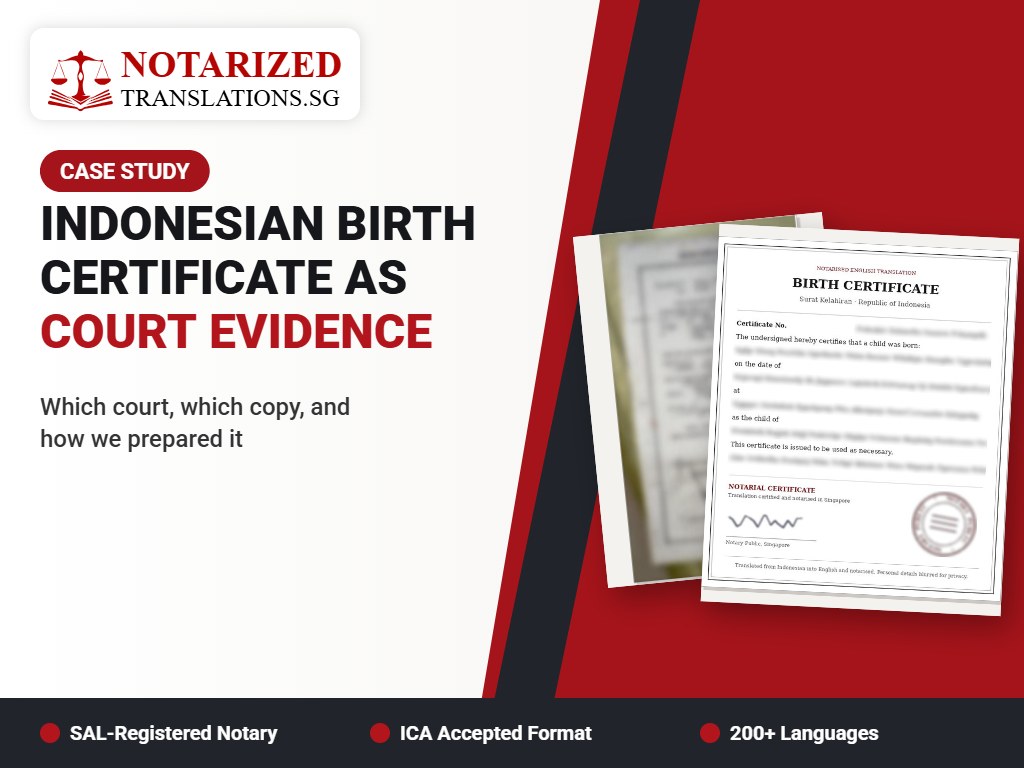
Imam’s enquiry was eleven words long. Please translate the birth certificate to English, thank you. Bahasa Indonesia to English, one page, notarised. In the purpose field he had chosen the option that said Legal / Court Use, and that was the entire brief.
Most enquiries that short are simple. This one was the opposite, and the reason is worth setting out properly, because it is the single thing people get wrong when a foreign-language document has to go in front of a court rather than across an immigration counter. “Court use” is not a requirement. It is a category containing several different requirements, and until you know which one you are in, you do not know what you are being asked to produce.
The gap in an eleven-word brief
An administrative submission tells you what it wants. A government body publishes an acceptance rule, you read it, you meet it, and the rule is the same for everyone who submits that week. Preparing a document for a legal process in Singapore is a different shape of problem, because the standard is set by the forum and by the party’s own lawyer, and the enquiry form has no field for either.
So the first question we asked Imam was not about his certificate. It was: who is going to receive this, and in what form will it reach them? There are several honest answers and they are not interchangeable. The document may be going to his own solicitor, to sit in a file and be exhibited later. It may be going in as an exhibit to an affidavit, which is the usual route for a civil-status document in Singapore proceedings. It may be wanted for a probate or estate process, where a registry has its own practice on foreign documents. It may be for a statutory declaration or a deed drawn up here. Or – and this happens more often than the phrase “court use” suggests – the proceedings may not be in Singapore at all, and the document is being prepared here to be sent to a court or authority abroad, which changes the chain entirely and adds steps after ours.
We could not guess, and guessing would have been expensive. A notarised translation is a finished, attested object. It is not a draft you can adjust once you find out what the recipient wanted, because the attestation is attached to the exact text that was attested. Get the form wrong and the work is done again from the top.
Why evidence is a harder audience than a counter
Here is the part that changes how the translation itself is built, and it is the part almost nobody is told.
When a translation goes to an administrative body, one reviewer reads it once, checks it against the original, and files it. Nobody is looking for a way to discredit it. When a translation goes into a legal process, it acquires a second reader with the opposite motive. The other side reads it looking for the gap – a date that does not match the stamp beside it, a marginal note that appears on the original but not in the English, a name spelled one way on this page and another way three exhibits later, a paragraph that has been quietly smoothed into better English than the original actually contains. Every one of those is a question somebody can ask, and a translation that invites questions has stopped doing its job even if every word in it is defensible.
Singapore proceedings are conducted in English, and a non-English document put before the court is expected to arrive with an English translation that someone identifiable stands behind. That is the hinge. The standing of the translation does not come from a logo on the letterhead; it comes from a named translator who has verified what they produced and can be identified as having done so, with the notarial layer recording that verification formally. Which is also why the usual shortcut – a quick in-house rendering by a bilingual relative or a colleague – tends to fail at exactly the moment it is relied on.
So we built Imam’s translation to be read adversarially:
- Nothing smoothed. Civil-registry language is often stiff, formulaic and slightly archaic. The English says what the Indonesian says, in the register the Indonesian uses. Improving a document’s prose in translation is a change to the evidence.
- Every mark on the page accounted for. Headers, the issuing office’s designation, the register reference, seal and stamp text, signature blocks, pre-printed form text, and any marginal or later annotation. On a civil-registry certificate these carry weight equal to the body text, and an absent one is a hole somebody will put a finger in.
- Illegible means illegible. Where something could not be read with confidence it is marked as not legible, in place, rather than reconstructed from context. A reconstruction that turns out to be wrong is far worse than an honest gap.
- Laid out to be read side by side. The English mirrors the original’s structure – same order, same field sequence, same page boundaries – so that a judge, a registrar or opposing counsel can put the two sheets next to each other and account for the whole document without being guided. A translation that reflows the original into tidy prose makes that check impossible, and the person doing the checking will not thank you for it.
- One rendering decision, held everywhere. If this certificate is going into a bundle with other documents, the way a name, a place, an office or a document title is rendered has to be the same in all of them. Two defensible renderings of the same name across two exhibits is not a translation problem; it is an argument handed to the other side. We fix the decision, write it down, and apply it to everything in the same matter – including documents we translate for that matter months later.
What we did not ask about
We never asked Imam what the legal process was about. Not out of squeamishness – because it is not our input. We need to know the forum and the form of delivery; we do not need to know the dispute, the family circumstances or who is on the other side of it. Knowing more would not improve the translation by one word, and it would put sensitive information in a file that has no business holding it.
There is a professional edge to this as well. A translator who knows the argument starts, without meaning to, translating towards it. The faintly helpful word choice, the annotation rendered in the way that reads better for the client, the ambiguity resolved in the useful direction. All of that is invisible to the person who did it and obvious to a reader who is looking for it. The safest translation of a document that is going into contested proceedings is one produced by someone who knows exactly what the document says and nothing at all about what either side hopes it will prove. Whether the certificate establishes anything is a question for Imam’s lawyer. Our job ends at a faithful English rendering of what is printed.
Scoping it with nothing to look at
The enquiry arrived with no file attached. That is common and it is not a problem, as long as nobody pretends otherwise. What it does mean is that the page count, the condition of the document and the format of the certificate were all unknown, so there was nothing honest to quote on yet.
We asked Imam for three things before anything else: the document itself, in a scan good enough that every stamp and marginal mark is readable rather than merely visible; a count of the physical sheets and printed faces, taken by picking the certificate up, not by counting files on a phone; and the name of the forum or the recipient. On the scan quality we were deliberately firm, because court work has less tolerance for guesswork than administrative work does. A faint impression on a counter submission might pass; the same faint impression in an exhibit is the thing counsel enlarges. If you are wondering whether a photograph of the certificate is enough to start with, our note on using a scanned copy for a notarised translation in Singapore sets out where a copy works and where it does not.
We also asked about the copy itself, which is the question in the title of this piece. A legal process usually has a view on which version of a document it will accept – the original, a certified true copy, or a copy certified by a particular person. Translating from whichever version happens to be nearest is how people end up with an immaculate translation of the wrong copy. The translation names the document it was made from, so if the recipient wants a different copy in the bundle, the translation has to be made from that one.
How the file was assembled
Once the forum and the delivery form were settled, the sequence was unglamorous and deliberately rigid.
- We confirmed the document back to Imam in writing – what we had received, how many pages and faces, which copy it was, and what the finished set would consist of. Nothing began until he agreed with that description.
- We fixed the rendering decisions before translating: how the name would appear, how the issuing office would be rendered, how annotations would be marked. Written down, not held in someone’s head.
- The certificate was translated in full, furniture included, with the layout mirroring the original and illegible elements flagged in place.
- A second pass checked the English against the original purely for completeness – not for style – asking only whether anything on the page is missing from the English.
- Imam reviewed the rendering of his own name and the personal details, which is the one part of the document where he is the authority and we are not.
- Only then was the notarial layer applied, to the final text, by a notary public – attesting the translator’s verification, not the truth of the certificate’s contents, which is a distinction worth understanding before you order. If the difference between a certified and a notarised translation is still fuzzy, the comparison of certified and notarised translation in Singapore is the short version.
- The original, the translation and the attestation were delivered as one set, in the order a recipient reads them, with a note on how to keep them together if the set is going to be exhibited.
Where proceedings or an authority outside Singapore are involved, this is the point at which our part stops being the whole chain. A notarised translation may then need authentication and, depending on the destination, consular legalisation or an apostille before it is usable abroad. We tell clients that before they order rather than after, because the sequence matters and a step taken out of order often has to be bought twice. Our pages on document legalisation and SAL authentication of notarised translations explain where each step sits.
How it turned out
The set went out inside the deadline. The notarial layer was in the form the recipient required, the seals and register markings were rendered rather than summarised, the name was handled as printed with the rendering decision recorded, and nothing came back with a query. Imam confirmed the translation did what he needed it to do and went into the file complete and on time.
Whatever the legal process decides is not ours to report and we make no claim about it. What we can say is what was in our control: a document that reached its recipient in English, in full, attributable to a named translator, attested in the right form, on the day it was needed, with no gap in it for anyone to argue about.
If you are in the same position
The useful lesson from Imam’s file is not about Indonesian documents. It is that the phrase “for court” is the start of a conversation, not the end of one.
Before you order, find out from your lawyer or the recipient which forum will receive the document, whether it goes in as an exhibit to an affidavit or in some other form, which copy of the original they will accept, and whether anything needs to happen to the translation after notarisation because it is leaving Singapore. Four questions, usually one email, and they determine the whole shape of what you should be buying. Ordering first and asking afterwards is how people end up with a perfectly good notarised translation that is the wrong object.
And send the document properly the first time. Every face of every sheet, scanned well enough that the faintest stamp is readable, with a sentence telling us how many sheets it physically is and which copy you are sending.
Our birth certificate notarised translation page sets out what the finished set contains, and if the certificate is one of several documents going into the same matter, the notarised translation of legal affidavits and court documents page covers the rest of that bundle. If you are not sure which of the four questions above applies to you, ask us through our contact page and we will tell you what to find out before you commit to anything.
The questions this one kept raising
My form said “legal or court use” – is that not enough to start from?
It tells us the general territory and nothing about the requirement. A document exhibited to an affidavit, a document held in a solicitor’s file, a document going to a registry, and a document being sent to a court in another country are four different jobs with four different finished forms. Tell us the recipient and we will tell you which one you are in. If you do not know yet, say that too – it is a fair answer, and the next step is to find out before anything is attested.
Can a family member who speaks both languages do the translation if it is then notarised?
The notarial layer records that a particular person verified a particular translation. It does not supply independence or competence that was not there, and a translation produced by someone with an interest in the matter is the first thing an opponent will point at. For anything that may be read in a contested setting, the translation should be attributable to an independent translator who is not connected to the parties.
Does the English have to look like the original, or can it just read well?
It should read naturally, but it must track the original’s structure – same sequence, same fields, same page breaks, seals and annotations shown where they sit. The recipient’s test is whether the two documents can be laid side by side and reconciled mark for mark. A translation reflowed into elegant continuous prose fails that test however good the English is.
There is handwriting in the margin that I think is just a filing note. Can it be left out?
No, and that call is not yours or ours to make. Marginal and later entries on civil-registry documents can be substantive, and the only safe approach is to render everything and mark anything genuinely unreadable as unreadable. A missing annotation on a document that is being scrutinised is an invitation to ask what else is missing.
I may need more documents translated for the same matter later. Does that change anything now?
Tell us at the start, because it changes how we record the rendering decisions. Names, places, office titles and document headings must be rendered identically across every document in one bundle, including documents that arrive months apart. Consistency across a bundle is far easier to build in from the first document than to retrofit onto the fourth.
The notarisation is done. Can a page be added afterwards?
Not to the existing attestation. Notarisation attaches to the exact translation that was attested, so an addition means the translation and the attestation are both done again. This is precisely why the page count, the faces and the choice of copy are settled in writing before a word is translated – the ten minutes at the start are what stop you paying twice.