The client’s problem
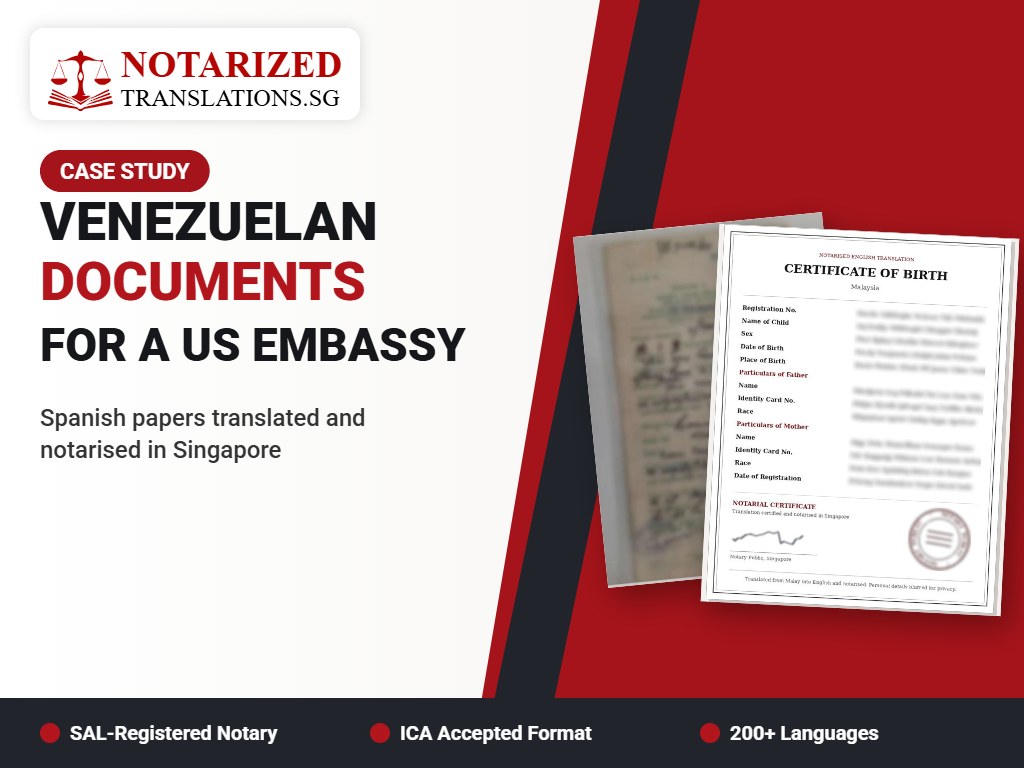
Jonathan’s enquiry was unusually well specified for a first contact. Two documents, one page each: a birth certificate issued in Venezuela, in Spanish, and a citizenship renunciation document. Both to be translated into English. Notarisation required. And the reader, stated plainly, was a United States embassy.
Everything about that is clear except the thing that makes it difficult, which is that there are three countries in the sentence. The documents are Venezuelan. The client is in Singapore. The authority reading them is American.
Almost every job this firm takes has two jurisdictions in it at most: a foreign document and a Singapore authority, or a Singapore document going abroad. Three is a different shape, and the usual mental model – translate, certify, notarise, authenticate, submit – does not map onto it cleanly.
Why it was harder than it looked
The first and largest problem is that nobody in Singapore can authenticate a Venezuelan document.
This needs stating carefully because it is the point on which clients lose the most time. Authentication, in the sense of a state vouching for the provenance of a document, is something a state does for its own documents. The Singapore Academy of Law authenticates Singapore documents so that they can be relied on abroad. It has no function in relation to a certificate issued by a Venezuelan civil registry, and it cannot acquire one. If the receiving authority requires the underlying Venezuelan originals to be authenticated, that authentication has to come from the issuing state, through its own channels, and no amount of work in Singapore substitutes for it.
What Singapore can do is notarise locally: a notary public here can attest to the translator’s signature and identity, and can attest that a copy corresponds to a document produced to them. Those are real and useful services, and they are what this client was asking for. But they are statements about the translation and the copy, not statements about the Venezuelan original. A client who buys notarisation in Singapore believing it has authenticated their foreign birth certificate has bought something genuine and has not bought what they thought.
Separating those two in a client’s mind, early, is worth more than anything else on this job.
The second problem is the second document, and it is the one that could actually cause harm if handled carelessly.
“Citizenship renunciation document” describes a category, not an instrument. Depending on the state and the stage, the piece of paper in a person’s hand may be an application to renounce, lodged but not yet determined. It may be a receipt or acknowledgement that such an application has been received. It may be a decision or instrument recording that nationality has in fact been lost, which in many systems requires a ministerial or presidential act and is published accordingly. These look superficially similar – same subject, same vocabulary, often the same issuing office – and they say completely different things about the person’s legal status.
A translator who titles the English version “Renunciation of Citizenship” because that is the phrase the client used has asserted, in a certified document going to a foreign government, that a change of nationality has occurred. If the document is in fact an application, that assertion is false, and it is false in a submission about the client’s own status, in a context where misdescribing nationality is not a trivial error.
So the rule on this job was: the English title of the document is determined by what the document is, established from its own text and its issuing authority, and not from the client’s description of it. Where the instrument’s effect is genuinely ambiguous on its face, the translation renders exactly what it says and does not characterise it.
The third problem is that the receiving authority’s requirements are not Singapore’s requirements, and cannot be inferred from them.
A foreign embassy operates under the consular practice of the state it represents. Its documentary rules are published by that state, they are specific to the process the applicant is in, and they frequently differ from the domestic chain a Singapore-based client is used to. Some consular processes want a certified translation and nothing else. Some specify who may translate. Some require the original foreign document to be authenticated in its country of issue. Some will accept a translation by any competent person provided a declaration accompanies it. Reading across from what ICA or the Ministry of Manpower would want is not merely unhelpful here; it is actively misleading, because the Singapore domestic chain tends to be longer and the client ends up buying steps nobody asked for.
Fourth, the Spanish itself. Venezuelan civil-registry instruments have their own nomenclature, their own layout conventions and their own registry reference structures, and the terminology for the same instrument differs across Spanish-speaking jurisdictions. A translator working from Peninsular habits will produce defensible English that quietly relocates the document to another country’s system. The document’s own markings – the issuing office, the register it cites, the legal basis printed on it – settle which system it belongs to.
And fifth, nothing was attached at first contact. Both documents were described, neither was seen.
How we approached it
We answered the enquiry with a scoping reply rather than a quote, and the reply made three separations explicit: what translation does, what notarisation in Singapore does, and what authentication of the Venezuelan originals would require and where it would have to be obtained. That is three short paragraphs, and it reorders the client’s whole plan.
We asked the client to send both documents, and asked one further question: what the embassy’s own instructions say about translations for the process they are in. If those instructions exist in writing, they govern, and working to them is cheaper and safer than working to a general standard.
On the documents themselves, we identified each before titling either. For the birth certificate that meant establishing the issuing registry and the legal basis cited on the face of it, which also determines how the registry references and the marginal annotations are rendered. For the renunciation document it meant reading what the instrument actually does – application, acknowledgement, or determination – and titling the English accordingly, with the original designation kept visible so the reader can see the instrument’s own name for itself.
Both documents were then translated as one job with one terminology set, which matters here because the two will be read together and refer to the same person and, in places, the same facts. Where the birth certificate and the renunciation document name the same place, office or status, they are rendered identically in English. Where they differ, the difference is preserved rather than harmonised.
Names were rendered to match the client’s travel document, with the form appearing on each original reproduced as it appears. Spanish-language civil records commonly carry both paternal and maternal surnames, in an order and with conventions that an English reader may reorganise unless the translation is explicit about which component is which – so we are explicit about it, because on an identity submission the structure of the name is part of the evidence.
Marginal annotations on civil-registry certificates were given particular attention. In many Spanish-language systems, the operative later facts about a person are recorded as notes in the margin of the original register entry rather than in the body, and a translation that renders the body and treats the margin as decoration can omit the most legally significant content on the page.
Dates were rendered with the month as a word. Seals, stamps, signature blocks and any security features were all accounted for. Anything illegible was marked illegible.
Finally, certification, and notarisation by a Singapore notary public attesting the translator’s signature – with the scope of that notarisation stated so that nobody downstream mistakes it for authentication of the Venezuelan originals.
What we delivered
One certified and notarised English set covering both documents: each instrument identified and titled by what it is rather than by what it was called in the enquiry, the status question left exactly as open as the source document leaves it, one consistent terminology across the pair, marginal annotations translated in full, surname structure made explicit, names matched to the travel document, all seals and registry references accounted for, illegible elements marked, and the scope of the Singapore notarisation stated on its face.
Delivered inside the deadline, in the form the client’s consular process called for, with the client told in writing – before paying – which steps Singapore could perform and which would have to come from Venezuela.
The result
The set went in complete and on time, with nothing queried. The client did not buy a Singapore authentication layer for a Venezuelan document, which is the specific waste this job was set up to prevent.
Decisions in a consular process belong to the authority running it, and this piece asserts nothing about the outcome, nor about the client’s nationality status, which the documents themselves leave to be read as they stand.
What a reader in the same position should know
If your documents were issued abroad and you are in Singapore, understand which steps are available here. A Singapore notary can attest a translator’s signature and a copy. Singapore cannot authenticate another country’s document. If the receiving authority wants your original authenticated, that comes from the country that issued it.
Find the receiving authority’s own instructions before you buy anything. An embassy’s documentary rules come from the state it represents, and they are often shorter than the Singapore domestic chain. Working to the wrong one costs money and days.
Be careful how you describe a document about your nationality. If you are not certain whether what you hold is an application, an acknowledgement or a final determination, say that. A good translator will establish it from the document; a translation that guesses it is a document you should not submit.
Send the margins. On Spanish-language civil certificates, the notes in the margin often carry the facts that matter most, and a photograph cropped to the printed body can lose them entirely.
You can read about this work on our notarised birth certificate translation and notarised translation of immigration documents pages. If you need to understand the difference between the local and the overseas chain, our SAL-authenticated notarised translation, apostille service and document legalisation pages set out what each step does. Our frequently asked questions cover the common queries, and you can book a translator or contact us with both documents and the embassy’s instructions, and we will tell you what is actually needed.